
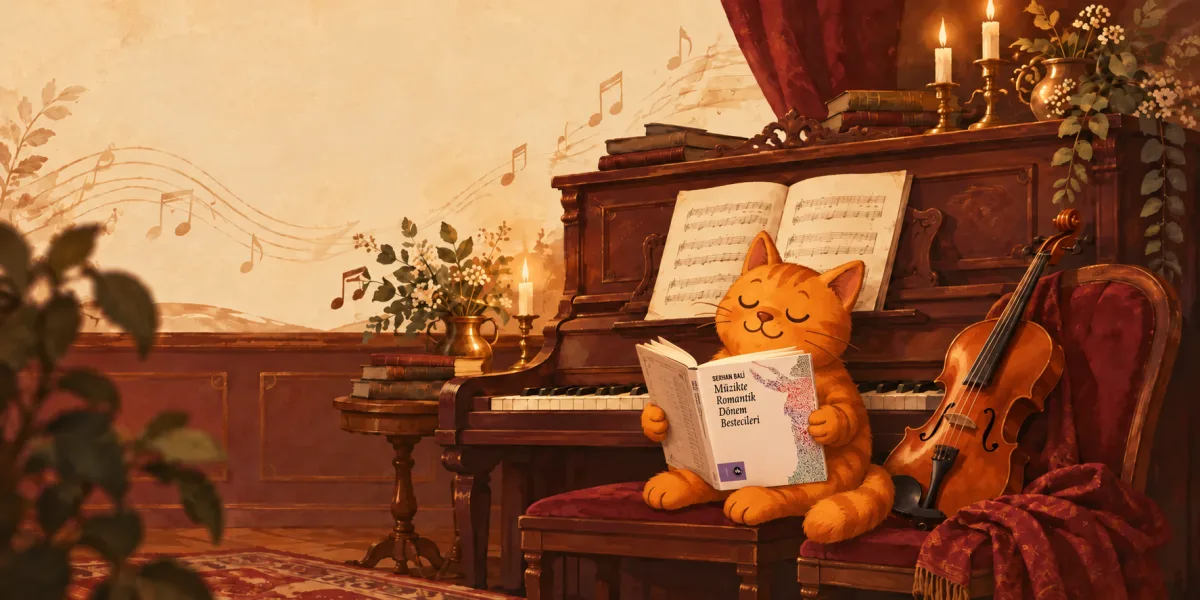
The playlist follows the chapter order of Serhan Bali’s Müzikte Romantik Dönem Bestecileri, published by VakıfBank Kültür Yayınları. This guide accompanies the Spotify playlist with original listening notes.
73 composers · 102 tracks · chapter order
Each composer introduction explains their place in music history; the nested track notes explain what the music expresses and why it was selected. The choices balance familiar entry points with representative discoveries: they reflect repertoire recognition and musical character, rather than a measured ranking of Spotify streams.
Track numbers and titles follow the saved playlist checked on 14 October 2026. “Piece” includes an aria, overture, movement or short composition; several recordings are arrangements or excerpts, identified where relevant. The book’s scope extends beyond strict nineteenth-century Romanticism to composers whose later music develops or challenges that tradition. These are original listening notes, not quotations or summaries of the book’s individual chapters.
1. Gaspare Spontini
Spontini was an Italian composer whose career in Paris and Berlin helped expand opera into a more imposing public spectacle. His dramatic orchestral writing connects Classical-era opera with the grandeur of nineteenth-century historical opera.
1. La vestale: Overture
The overture to La vestale introduces the solemn, ceremonial world of an opera about duty, religion and forbidden love. It was chosen as an accessible orchestral doorway into Spontini’s signature operatic achievement and his importance to the development of grand dramatic scale.
2. Niccolò Paganini
Paganini transformed the violin virtuoso into an almost mythical public figure through extraordinary technique and theatrical presence. His compositions make that virtuosity audible, while his influence reaches into the piano music of Liszt and Rachmaninoff.
2. Paganini: 24 Caprices, Op. 1: No. 24 in A Minor
Caprice No. 24 turns a memorable theme into a succession of increasingly demanding variations for unaccompanied violin. It is a natural choice because it both embodies Paganini’s technical imagination and supplies the theme later composers repeatedly reinvented, including Rachmaninoff near the playlist’s end.
3. Violin Concerto No. 2 in B Minor, Op. 7, MS. 48: III. Rondo à la clochette, ‘La campanella’
The finale of Violin Concerto No. 2 combines dazzling violin writing with the recurring bell effect that gives La campanella its name. It complements the solo caprice by showing Paganini’s theatrical side with orchestra, and lets you hear the source behind Liszt’s piano study later in the playlist.
3. Daniel Auber
Auber was a leading French opera composer, particularly associated with opéra comique, a tradition using spoken dialogue alongside music. His gifts for clear melody, buoyant rhythm and theatrical pacing made his music central to nineteenth-century Parisian entertainment.
4. Fra Diavolo: Overture
The Fra Diavolo overture offers a compact sequence of lyrical and lively theatrical ideas. It was chosen because it conveys Auber’s wit and melodic ease without requiring familiarity with the opera’s story or a complete stage performance.
4. Carl Maria von Weber
Weber helped establish German Romantic opera through supernatural subjects, forest imagery and vividly atmospheric orchestration. His music made the orchestra an active participant in a drama’s emotional and imaginative world.
5. Der Freischütz, J. 277: Overture
The Der Freischütz overture contrasts horn-colored woodland atmosphere with darker, threatening music before its triumphant resolution. It is a defining introduction to Weber because the opposition between nature, supernatural fear and redemption is audible in a single orchestral piece.
5. Giacomo Meyerbeer
Meyerbeer was a major architect of French grand opera, combining spectacular staging, historical conflict and demanding vocal writing. His influence on nineteenth-century operatic institutions was much larger than his relatively limited presence in today’s everyday listening suggests.
6. Les Huguenots / Act 1: “Nobles seigneurs salut…Une dame noble et sage”
Urbain’s entrance music from Les Huguenots is agile and ceremonious, displaying the brilliant vocal decoration associated with Meyerbeer’s stage writing. It was chosen to make a large, demanding opera approachable through an attractive standalone excerpt, rather than to represent its entire historical drama.
6. Gioachino Rossini
Rossini brought irresistible rhythmic energy, vocal brilliance and expertly timed comedy to Italian opera. His later French works also reveal a broader dramatic ambition beyond the comic style most listeners first associate with him.
7. Rossini: Il Barbiere di Siviglia, Act I: “Largo al factotum” (Figaro)
Figaro’s Largo al factotum announces a character bursting with confidence through rapid delivery, repeated calls and exuberant melodic gestures. It was chosen as an immediately recognizable example of Rossini turning vocal virtuosity into comic characterization.
8. William Tell: Overture (Finale)
The famous finale of the William Tell overture uses a galloping rhythm and bright orchestral momentum to create exhilaration. It adds Rossini’s orchestral spectacle to the playlist, while representing only the concluding portion of a much more varied overture.
7. Franz Berwald
Berwald was a Swedish composer whose distinctive symphonies received greater recognition after his lifetime. His orchestral music combines Classical clarity with unexpected turns of phrase, texture and structure.
9. Symphony No. 3 in C Major, “Sinfonie singuliere”: I. Allegro fuocoso
The opening movement of Sinfonie singulière moves with energetic orchestral exchanges and a character that can feel both clear-cut and surprising. It was chosen to introduce Berwald through one of his important symphonies and to show that Romantic orchestral invention extended beyond the most familiar German and Austrian names.
8. Franz Schubert
Schubert combined an exceptional gift for song melody with harmonies that can shift the emotional meaning of a phrase almost imperceptibly. His songs, piano pieces and chamber music give Romantic inwardness an unusually direct and intimate voice.
10. Ave Maria, D. 839
The melody known as Ave Maria creates a sense of prayerful stillness through its long vocal line and gentle accompaniment; the original song is Ellens Gesang III, associated with a German text drawn from Walter Scott rather than an original setting of the Latin prayer. It was chosen for its recognizability and for the way it demonstrates Schubert’s ability to make a melody feel both simple and deeply expressive. [S1]
11. 4 Impromptus, Op. 90, D. 899: No. 3 in G-flat major
Impromptu No. 3 places a sustained, songlike melody above flowing piano accompaniment. It complements Ave Maria by showing how Schubert transfers the expressive logic of a singer’s line into a purely instrumental work.
9. Gaetano Donizetti
Donizetti was one of the central composers of Italian bel canto, where flexible, beautifully shaped singing carries dramatic meaning. His range includes both tender comedy and tragedy in which vocal elegance intensifies emotional distress.
12. L’elisir d’amore, Act II: Una furtiva lagrima
In Una furtiva lagrima, Nemorino interprets a tear as evidence that his love is returned, and the restrained melody turns that hope into a moment of vulnerability. It was chosen as a signature Donizetti aria in which expressive phrasing matters more than overt vocal display.
13. Donizetti: Lucia di Lammermoor, Act 3: “Il dolce suono” (Lucia)
Il dolce suono opens Lucia’s famous mad scene, where remembered love and fractured perception disturb the apparent beauty of the vocal line. This excerpt provides the tragic counterpart to Una furtiva lagrima and introduces the Romantic fascination with psychological extremes.
10. Fromental Halévy
Halévy was a French opera composer whose La Juive occupies an important place in the grand-opera tradition. His dramatic writing brings personal suffering into conflict with public institutions and religious intolerance.
14. La Juive, Acte IV: “Rachel, quand du Seigneur”
Éléazar’s aria Rachel, quand du Seigneur concentrates the opera’s moral and emotional anguish in a powerful tenor solo. It was chosen because this celebrated excerpt gives Halévy a distinctive voice in the playlist through sustained dramatic intensity rather than spectacle alone.
11. Albert Lortzing
Lortzing helped shape German comic opera by combining tuneful music with accessible theatrical characters and situations. His works preserve a lighter, conversational strand of Romantic musical theatre alongside the period’s monumental tragedies.
15. Lortzing: Zar und Zimmermann, Act I: ‘O sancta justitia’
O sancta justitia is a comic bass showcase from Zar und Zimmermann, with pompous declamation turning authority into something amusing. It was chosen because it makes Lortzing’s characterization and comic timing immediately audible, balancing the more anguished operatic selections around it.
12. Vincenzo Bellini
Bellini is especially associated with long, seemingly effortless vocal melodies and the expressive restraint of Italian bel canto. His dramas often depend on the tension between an outwardly poised musical line and intense private emotion.
16. Bellini: Norma, Act 1: “Casta diva” (Norma, Coro)
In Casta diva, Norma’s invocation unfolds in exceptionally long, serene phrases. It was chosen as the clearest introduction to Bellini’s melodic style: the drama is carried by breath, line and emotional shading rather than constant rapid motion.
13. Hector Berlioz
Berlioz expanded the orchestra’s expressive range through bold instrumentation and music linked to stories, images and psychological states. His work is central to Romantic programme music, in which an instrumental composition invites a narrative interpretation.
17. Symphonie fantastique, Op. 14, H 48: IV. Marche au supplice
The March to the Scaffold from Symphonie fantastique depicts a terrifying dream through heavy marching rhythms, sharp orchestral contrasts and a brutally interrupted recollection of the beloved’s theme. It was chosen as a vivid example of Berlioz making an orchestra narrate an event rather than merely establish a mood.
14. Adolphe Adam
Adam was a French composer of opera and ballet, with Giselle remaining his most enduring contribution to the stage. His music supports the dancing and dramatic atmosphere that became central to Romantic ballet.
18. Giselle: Valse
The waltz from Giselle presents the graceful, lilting dance language surrounding the ballet’s human world. It was chosen to represent Romantic ballet through an inviting dance number and to give Adam a place beyond the better-known ballet music of Tchaikovsky.
15. Mikhail Glinka
Glinka helped establish a distinctly Russian voice in concert and operatic music while drawing on European compositional traditions. Later Russian composers regarded his operas as important precedents for national musical identity.
19. Ruslan and Ludmila: Overture
The Ruslan and Lyudmila overture combines rushing strings, bright orchestral energy and an atmosphere of adventure. It was chosen because it is a familiar concert piece that makes Glinka’s theatrical vitality immediately accessible without requiring the complete opera.
16. Felix Mendelssohn
Mendelssohn united Romantic imagination with unusually clear forms and polished orchestral craftsmanship. His music can be lyrical, dramatic or fantastical while retaining a strong sense of proportion and balance.
20. Wedding March
The Wedding March from A Midsummer Night’s Dream has become familiar far beyond the theatre for which it was written. It was chosen as a recognizable entry point; the playlist’s organ recording also illustrates the piece’s later life outside its original orchestral setting.
21. Mendelssohn: Violin Concerto in E Minor, Op. 64, MWV O14: I. Allegro molto appassionato
The Violin Concerto’s first movement begins with the soloist’s passionate melody rather than an extended orchestral introduction. It complements the public ceremonial march by revealing Mendelssohn’s lyrical warmth and the seamless relationship he builds between violin and orchestra.
17. Frédéric Chopin
Chopin made the piano a vehicle for highly personal expression, combining singing melody with sophisticated harmony and flexible rhythm. His largely piano-centered output helped establish the short character piece as a major Romantic art form.
22. Chopin: Nocturne No. 2 in E-Flat Major, Op. 9 No. 2
The E-flat major nocturne uses a gently rocking accompaniment and an increasingly ornamented melodic line to create an intimate, vocal quality. It was chosen as one of the most approachable demonstrations of Chopin’s lyrical style and the expressive possibilities of the nocturne.
23. Fantaisie-Impromptu in C-Sharp Minor, Op. 66
Fantaisie-Impromptu contrasts restless outer sections with a broad, lyrical middle section, while different rhythmic groupings in the two hands create its flowing tension. It provides the more turbulent and virtuosic counterpart to the nocturne, showing that Chopin’s piano language includes brilliance as well as delicacy.
18. Otto Nicolai
Nicolai was a German composer and conductor whose best-known opera combines German theatrical traditions with an Italianate sense of vocal melody. His career also links the operatic stage with the developing professional orchestral world of nineteenth-century Vienna.
24. The Merry Wives of Windsor Overture
The overture to The Merry Wives of Windsor moves from atmospheric preparation into lively comic activity. It was chosen because it remains an effective standalone concert piece and introduces Nicolai through the work most closely associated with his name.
19. Robert Schumann
Schumann brought literary imagination, shifting moods and a deeply personal voice into piano music, songs and larger instrumental works. His Romanticism often feels like an inner conversation between tenderness, agitation and fantasy.
25. Träumerei
Träumerei, or “Dreaming,” compresses a nostalgic, songlike idea into a short piano miniature. It was chosen because its apparent simplicity opens directly onto Schumann’s inward world, where subtle harmonic movement carries emotional weight.
26. Piano Concerto in A Minor, Op. 54: I. Allegro affettuoso
The Piano Concerto’s first movement connects a forceful opening with intimate dialogue between soloist and orchestra. It expands the picture offered by Träumerei, demonstrating how Schumann’s poetic, conversational style can organize a large concert work.
20. Ole Bull
Bull was a Norwegian violin virtuoso whose musical career was closely connected with the promotion of Norwegian cultural identity. His surviving music offers a useful bridge between the international virtuoso tradition and national melodic character.
27. Sæterjentens Søndag - The Herdgirls Sunday
The Herdgirl’s Sunday offers a gentle, pastoral melody rather than a relentless display of virtuosity. It was chosen to introduce Bull through a lyrical Norwegian-associated piece and to show the expressive, singing side of a celebrated violin showman.
21. Ambroise Thomas
Thomas was a French opera composer whose music combines lyrical elegance with the theatrical conventions of his period. His reputation today rests especially on Mignon and Hamlet.
28. Mignon, Act I: Connais-tu le pays?
In Connais-tu le pays?, Mignon longs for an idealized homeland through a melody shaped by remembrance and yearning. It was chosen for that direct Romantic connection between song and longing; the playlist’s Adelina Patti recording also provides a historical contrast to modern operatic recordings. [S2]
22. Franz Liszt
Liszt expanded both piano technique and the public image of the virtuoso performer, while also becoming an influential composer of orchestral programme music. His piano works range from intimate meditation to dazzling theatrical display.
29. Liebestraum No. 3 in A-Flat Major, S. 541 / 3
Liebestraum No. 3, or “Dream of Love,” develops a broad, singing melody through increasingly rich piano textures. It was chosen to represent Liszt’s lyrical side and to make clear that his expressive range extends beyond technical spectacle.
30. La campanella in G-Sharp Minor (From “Grandes études de Paganini”, S. 141/3)
Liszt’s La campanella transforms material from Paganini into belllike piano writing with exposed leaps and glittering passagework. It was chosen both as a celebrated virtuoso piece and as a direct comparison with Paganini’s concerto finale earlier in the playlist.
23. Friedrich von Flotow
Flotow was a German opera composer whose melodic style drew strongly on French and Italian theatrical influences. Martha preserves his ability to write tunes that travel easily beyond the opera house.
31. Martha / Act 3: “M’appari”
The tenor aria known as M’appari expresses longing in a warmly sustained melodic line. It was chosen as Flotow’s most recognizable operatic calling card, showing how a memorable aria can preserve the reputation of a less frequently staged composer.
24. Richard Wagner
Wagner reshaped opera through continuous musical drama, recurring motives and an unusually powerful orchestral role. His chromatic harmony and large-scale dramatic thinking influenced composers well beyond the opera house.
32. Ride of the Valkyries
The Ride of the Valkyries turns a bold recurring motive and surging orchestration into an unmistakable scene of motion and power. It was chosen as an immediate introduction to Wagner’s dramatic orchestral imagination and his ability to make a musical idea identify a whole theatrical world.
33. Tristan und Isolde, Act III: Liebestod (Concert Version)
The Liebestod builds through extended harmonic tension toward a sense of release at the end of Tristan und Isolde. It balances the force of the Ride with Wagner’s sustained emotional intensity; this playlist uses the orchestral concert version of the music associated with Isolde’s final scene.
25. Charles-Valentin Alkan
Alkan was a French pianist-composer whose music combines exceptional technical demands with unusually ambitious forms and eccentric imagination. His work offers an important alternative to the better-known virtuoso worlds of Chopin and Liszt.
34. Le Festin D’Esope Op. 39 No. 12
Le festin d’Ésope subjects a compact theme to a succession of sharply contrasting, technically brilliant variations. It was chosen because it introduces both Alkan’s formidable pianism and his capacity for concentrated character changes within a single substantial work. [S3]
26. Giuseppe Verdi
Verdi placed memorable melody at the service of sharply defined characters and urgent dramatic situations. His operas helped shape nineteenth-century Italian cultural life and remain central to the international operatic repertoire.
35. Rigoletto, Act III: La donna è mobile
The Duke’s La donna è mobile is outwardly carefree and catchy, while its dramatic context exposes the character’s shallow view of women. It was chosen because its immediate popularity demonstrates Verdi’s melodic gift without erasing the distinction between a character’s words and the composer’s own perspective.
36. La traviata, Act I: Libiamo ne’ lieti calici “Brindisi”
Libiamo ne’ lieti calici, the drinking song from La traviata, turns a social celebration into a sparkling duet and chorus. It complements the solo aria by showing Verdi’s talent for ensemble energy and for placing memorable music inside the social world of a drama.
27. Charles Gounod
Gounod was a French composer whose lyrical voice flourished in both opera and sacred music. His melodies often favor warmth, clarity and expressive directness over overt theatrical violence.
37. Ave Maria
Gounod’s Ave Maria adds a new singing line to the harmony of Bach’s C-major Prelude, creating a dialogue between Romantic melody and an earlier musical foundation. It was chosen for its familiarity and that historical connection; the playlist presents the melody through cello and piano rather than a sung prayer.
28. Jacques Offenbach
Offenbach made operetta a vehicle for wit, satire and irresistible theatrical rhythm. His output also includes more lyrical and emotionally ambiguous music, especially in The Tales of Hoffmann.
38. Offenbach: Barcarolle. “Belle nuit, ô nuit d’amour” (Les Contes d’Hoffmann)
The barcarolle’s gently rocking rhythm and intertwined voices evoke the movement of a boat and a seductive nocturnal atmosphere. It was chosen to represent Offenbach’s lyrical elegance, offering a different experience from the exuberance of his comic dance music.
39. Galop infernal (Arr. M. Sollini)
The Galop infernal is widely recognized as the tune associated with the can-can, and its headlong energy captures Offenbach’s comic brilliance. It was chosen as the lively counterpart to the barcarolle; this recording is Marco Sollini’s piano arrangement, rather than the original theatrical orchestration.
29. Franz von Suppé
Suppé was an important composer of Viennese operetta whose overtures often outlived the stage works they introduced. His orchestral style blends theatrical grandeur with quick changes of mood and buoyant rhythmic energy.
40. Light Cavalry: Overture
The Light Cavalry overture contrasts ceremonial brass writing with lyrical passages and an energetic galloping conclusion. It was chosen because it remains Suppé’s familiar concert-hall introduction and summarizes his gift for theatrical orchestral effect.
30. Henri Vieuxtemps
Vieuxtemps was a Belgian violinist-composer who helped develop the Romantic concerto as more than a platform for isolated technical tricks. His violin writing combines brilliant execution with a broad, singing line and substantial orchestral support.
41. Vieuxtemps: Violin Concerto No. 5 in A Minor, Op. 37: I. Allegro non troppo
The first movement of Violin Concerto No. 5 brings dramatic orchestral preparation together with flexible, lyrical solo writing. It was chosen to represent Vieuxtemps through an enduring concerto and to add a distinct voice to the playlist’s Paganini–Mendelssohn–Bruch violin tradition.
31. César Franck
Franck was a Belgian-born composer active in France, known for chromatic harmony and for linking movements through returning themes. His music often creates a sense of patient transformation rather than a sequence of disconnected episodes.
42. Violin Sonata in A major, FWV 8: IV. Allegretto poco mosso
The Violin Sonata’s finale passes its memorable melody between the instruments in an imitative, canon-like dialogue. It was chosen as an accessible example of Franck’s warmth and structural craftsmanship, with violin and piano functioning as genuine partners.
32. Édouard Lalo
Lalo was a French composer whose instrumental music combines rhythmic definition with vivid melodic character. His best-known works helped enrich the Romantic repertoire for solo instruments and orchestra.
43. Symphonie espagnole, Op. 21: I. Allegro non troppo
The first movement of Symphonie espagnole gives the violin a bold, rhythmically animated role within music colored by a French composer’s idea of Spain. It was chosen because this concerto-like work is Lalo’s signature achievement and offers a lively contrast to the more inward violin selections.
33. Bedřich Smetana
Smetana was a foundational figure in Czech national music, bringing local history, landscape and dramatic life into opera and orchestral composition. His work demonstrates how Romantic music could make cultural identity audible.
44. Vltava (The Moldau)
Vltava follows an imagined journey along the river through flowing musical textures and contrasting episodes. It was chosen as Smetana’s most familiar orchestral work and as a clear example of landscape, narrative and national identity joining in programme music.
34. Anton Bruckner
Bruckner created monumental symphonies built from broad spans, repeated patterns and powerful brass sonorities. His background as an organist and his religious life help explain the architectural and devotional character often heard in his music.
45. Bruckner: Symphony No. 7 “Adagio” by Wilhelm Furtwängler - 2024 Remastered, Berlin 1942
The Seventh Symphony’s Adagio unfolds slowly toward immense emotional peaks, emphasizing sustained development rather than a quickly memorable refrain. It was chosen as an introduction to Bruckner’s solemn expressive world; the playlist uses a historical Furtwängler performance, whose recording sound differs from modern studio productions.
35. Johann Strauss II
Strauss II elevated the Viennese waltz into a richly crafted concert and theatrical form. His music also belongs to the social world of ballroom entertainment and operetta, an essential part of nineteenth-century musical culture.
46. Blue Danube Waltz
The Blue Danube develops a sequence of waltz melodies into a larger arc with introduction and conclusion. It was chosen as Strauss’s defining popular work and as an example of dance music becoming a lasting orchestral concert piece.
47. Die Fledermaus: Overture
The Die Fledermaus overture weaves together sparkling themes from the operetta with brisk theatrical transitions. It complements the waltz by showing how Strauss’s rhythmic elegance also animates characters, comedy and ensemble action on stage.
36. Louis Moreau Gottschalk
Gottschalk was an American piano virtuoso whose music drew on the cultural sound worlds of New Orleans and his travels in the Caribbean and Latin America. His work broadens a European-centered view of Romantic piano music.
48. The Banjo - Remaster/1992
The Banjo uses repeated notes, sharply profiled rhythms and sparkling piano textures to evoke the sound and energy associated with its title. It was chosen because it makes Gottschalk’s distinctive cultural references and virtuoso showmanship audible in a compact piano piece.
37. Alexander Borodin
Borodin was a Russian composer and professional chemist, associated with the nationalist group known as the Five. His music is especially valued for expansive melody, rich harmony and vividly imagined dramatic settings.
49. Prince Igor: Polovtsian Dances (With Chorus)
The Polovtsian Dances from Prince Igor combine sweeping choral melody with forceful, contrasting dances. They were chosen as Borodin’s recognizable orchestral-and-choral showcase, also illustrating the nineteenth-century practice of imagining other cultures through theatrical musical color.
38. Johannes Brahms
Brahms combined Romantic expressiveness with close attention to inherited forms and motivic development. Alongside his large symphonies and chamber works, he wrote short pieces and dances of extraordinary melodic appeal.
50. Hungarian Dance No. 5
Hungarian Dance No. 5 alternates sharply accented energy with more flexible, lyrical gestures in the style of the Hungarian-associated urban dance music Brahms encountered. It was chosen for its immediate recognizability; the playlist’s violin-led recording shows the tune’s adaptability beyond the piano-duet collection in which the dances first appeared.
51. 16 Waltzes, Op. 39: No. 15 in A-Flat Major
Waltz No. 15 offers a tender melody within a brief, gently swaying piano miniature. It was chosen as an intimate counterweight to the Hungarian Dance, revealing Brahms’s ability to make restrained music feel emotionally full.
39. Henryk Wieniawski
Wieniawski was a Polish violin virtuoso whose compositions balance technical brilliance with a strongly lyrical performing tradition. His music remains important in the violin repertoire because it gives performers both expressive and technical opportunities.
52. Wieniawski: Légende in G Minor, Op. 17
Légende begins with a melancholy, singing violin line and develops into a more impassioned middle section. It was chosen to emphasize Wieniawski’s expressive voice, rather than introducing him only through fast or conspicuously difficult showpieces.
40. Amilcare Ponchielli
Ponchielli was an Italian opera composer best remembered for La Gioconda. His stage writing belongs to the tradition of large-scale melodic drama that links the world of Verdi with later Italian opera.
53. Dance of the Hours
The ballet sequence Dance of the Hours contrasts graceful dance music with a jubilant finale. It was chosen as Ponchielli’s best-known independent concert excerpt and as a reminder that a composer’s lasting public reputation can rest on music written for a scene within an opera.
41. César Cui
Cui was a Russian composer, critic and member of the Five, although his own music often favors smaller, lyrical forms over the monumental works associated with some of his colleagues. His chamber miniatures offer an approachable way into a composer whose critical influence exceeded his present-day popularity.
54. Orientale No. 9, Op. 50 from Kaleidoscope
Orientale is a brief violin-and-piano miniature from Kaleidoscope, shaped around a memorable lyrical gesture. It was chosen as an accessible example of Cui’s small-scale craftsmanship and as a change of scale after the playlist’s larger orchestral and operatic works. [S4]
42. Camille Saint-Saëns
Saint-Saëns combined prodigious instrumental skill with clear forms, elegant melodies and an exceptionally varied output. His music can be lyrical, witty or vividly theatrical while remaining carefully controlled.
55. Carnival of the Animals, R. 125: The Swan
The Swan gives the cello a long, graceful melody above rippling piano accompaniment. It was chosen as a familiar example of Saint-Saëns’s lyrical economy, where a small amount of material creates a vivid and enduring musical image.
56. Danse macabre
Danse macabre imagines a nocturnal dance of the dead through a conspicuous solo violin, rhythmic insistence and striking orchestral effects. It contrasts with The Swan by revealing Saint-Saëns’s playful, supernatural side and his skill at orchestral storytelling.
43. Mily Balakirev
Balakirev was a central organizer and mentor of the Russian nationalist circle known as the Five. His own music combines folk-associated materials and vivid color with the demands of virtuoso performance.
57. Balakirev : Islamey
Islamey builds a brilliant piano fantasy from dance-like materials associated with the Caucasus. It was chosen as Balakirev’s most recognizable virtuoso work and as an example of Romantic fascination with musical places and cultures beyond Western Europe.
44. Georges Bizet
Bizet was a French composer whose dramatic gifts appear especially clearly in sharply characterized melody and rhythm. Carmen became one of the central works of opera through its musical vitality and its unusually forceful presentation of character and desire.
58. Carmen: Habanera
The Habanera presents Carmen through a persistent dance rhythm and a descending, chromatic melody that suggests attraction and independence. It was chosen as Bizet’s immediately recognizable signature; this playlist recording highlights the tune through an orchestral presentation rather than a credited vocal soloist.
59. Carmen, Act II: Votre toast, je peux vous le rendre
The Toreador Song gives Escamillo a confident public identity through a broad refrain and martial rhythmic character. It complements the Habanera by showing how Bizet creates a contrasting personality within the same opera through a different kind of memorable song.
45. Max Bruch
Bruch was a German Romantic composer with a strong gift for long melodic lines, particularly in music for strings. His enduring reputation is concentrated in a small number of works that remain central to instrumental performance.
60. Bruch: Violin Concerto No. 1 in G Minor, Op. 26: II. Adagio
The Adagio of Violin Concerto No. 1 lets the solo instrument sing through an extended succession of warm, expressive phrases. It was chosen as the concerto’s lyrical heart and as a particularly direct introduction to the melodic quality that keeps Bruch in the standard repertoire.
46. Modest Mussorgsky
Mussorgsky sought a direct musical language rooted in dramatic speech, vivid imagery and Russian experience. His sometimes unconventional writing left an important legacy, even though several familiar performances use later revisions or orchestrations.
61. Pictures at an Exhibition (Orch. Ravel): Promenade I
The opening Promenade from Pictures at an Exhibition represents the listener’s imagined movement between pictures through a broad, unevenly paced theme. It was chosen for its distinctive character and its role as the suite’s recurring frame; the playlist uses Ravel’s orchestration of Mussorgsky’s original piano music.
62. Night on Bald Mountain
Night on Bald Mountain evokes a frightening supernatural gathering through restless motion and sharply contrasting orchestral episodes. It was chosen as Mussorgsky’s familiar dramatic counterpart to the Promenade, heard here in the standard concert tradition associated with Rimsky-Korsakov’s reworking.
47. Pyotr Ilyich Tchaikovsky
Tchaikovsky combined expansive melody with acute theatrical instinct in ballet, opera and orchestral music. His work often makes conflict, longing or fantasy immediately tangible through its musical gestures.
63. Tchaikovsky: Swan Lake, Op. 20, Act 2: No. 10, Scene. Moderato
The Act II scene from Swan Lake introduces the swan theme with a haunting melody that grows into a fuller orchestral statement. It was chosen as a compact example of Tchaikovsky making a melody carry both a character’s identity and the ballet’s emotional atmosphere.
64. Dance of the Sugar Plum Fairy
The Dance of the Sugar Plum Fairy creates an enchanted atmosphere through its delicate melody and the belllike sound associated with the celesta. It complements Swan Lake by showing Tchaikovsky’s gift for lightness and distinctive instrumental color rather than tragic intensity alone.
48. Emmanuel Chabrier
Chabrier was a French composer whose music is marked by rhythmic freshness, vivid color and a distinctive sense of humor. His harmonic and orchestral imagination helped open paths that later French composers developed further.
65. Chabrier: España
España turns Spanish-associated dance rhythms and bright orchestral colors into an exuberant rhapsody. It was chosen as Chabrier’s signature concert work and as a clear example of travel and cultural fascination feeding Romantic orchestral invention.
49. Antonín Dvořák
Dvořák combined Czech musical identity with the international forms of symphony, chamber music and concerto. His melodic generosity and rhythmic vitality allowed locally rooted music to reach a broad audience.
66. Symphony No. 9 in E Minor, Op. 95 “From the New World”: II. Largo
The Largo from the New World Symphony centers on a spacious English-horn melody within a contemplative orchestral setting. It was chosen for its familiarity and emotional breadth; the melody later associated with “Goin’ Home” originated in the symphony, rather than being a pre-existing song that Dvořák simply quoted.
67. Humoresque, Op. 101, No. 7
Humoresque No. 7 offers a gently lilting melody with enough contrast to make a small piece feel like a complete emotional journey. It complements the Largo’s symphonic scale, and this violin recording shows how a tune from Dvořák’s piano collection gained an independent life through arrangement.
50. Jules Massenet
Massenet was a leading French opera composer with a particular gift for intimate feeling and lyrical characterization. His music often conveys tenderness, hesitation or sensual atmosphere through finely shaped melodic lines.
68. Thaïs: Méditation
The Méditation from Thaïs gives the violin an intensely lyrical role during an instrumental interlude in the opera’s drama. It was chosen as Massenet’s most familiar standalone concert piece and as an example of an orchestra and solo instrument expressing a character’s inward change without words.
51. Edvard Grieg
Grieg developed a recognizable Norwegian musical voice through melody, dance rhythm and harmony, often working in comparatively short forms. His music can suggest landscape and folklore without losing its intimate, personal scale.
69. Morning Mood
Morning Mood unfolds a gentle pastoral melody that gradually brightens through orchestral color; in the original Peer Gynt drama, its setting is North Africa rather than a Norwegian sunrise. It was chosen for its recognizability and for Grieg’s ability to create an atmosphere with economical means; the playlist recording is a short presentation of the piece.
70. Peer Gynt, Op. 23: IV. In the Hall of the Mountain King
In the Hall of the Mountain King intensifies a repeated idea through faster motion, increasing volume and denser orchestration. It was chosen as the dramatic counterpart to Morning Mood, showing how Grieg can turn a simple pattern into a compelling theatrical escalation.
52. Nikolai Rimsky-Korsakov
Rimsky-Korsakov was a Russian composer celebrated for orchestration, imaginative storytelling and richly colored stage and concert works. He also played an important role in teaching and in shaping the performing versions of other Russian composers’ music.
71. Flight of the Bumblebee
Flight of the Bumblebee converts rapid, closely spaced notes into the impression of a buzzing insect in motion. It was chosen as a recognizable demonstration of musical illustration and virtuosity, heard here in a violin-led version rather than the original operatic setting.
72. Scheherazade: The Young Prince
The selection titled Scheherazade: The Young Prince presents the lyrical character associated with the third movement of the orchestral suite. It was chosen to balance the Bumblebee’s speed with Rimsky-Korsakov’s melodic warmth, although this shorter recording should not be mistaken for the complete orchestral movement The Young Prince and the Young Princess.
53. Pablo de Sarasate
Sarasate was a Spanish violin virtuoso whose compositions combine elegant instrumental writing with striking dance and melodic character. His showpieces remain attractive because their technical brilliance is closely connected to style and personality.
73. Sarasate: Zigeunerweisen, Op. 20
Zigeunerweisen contrasts a slow, expressive opening with increasingly brilliant fast music in a stylized Romani-associated idiom. It was chosen as Sarasate’s defining concert showpiece, displaying both the singing and spectacular sides of Romantic violin performance.
54. Gabriel Fauré
Fauré developed a refined French musical voice through supple melody, subtle harmony and carefully balanced textures. His expressive strength often lies in understatement rather than overt theatrical display.
74. Fauré: Pavane, Op. 50
The Pavane adapts the idea of a stately dance into graceful, gently melancholic orchestral music. It was chosen as an accessible introduction to Fauré’s elegance, where expressive color emerges through restraint and small harmonic shifts.
75. In Paradisum
In paradisum, the final movement of Fauré’s Requiem, offers consolation through a floating melodic line and a sense of luminous calm. It was chosen to represent his sacred music’s gentleness, with the playlist using Hayato Sumino’s piano presentation rather than the original choral-and-instrumental setting.
55. Francisco Tárrega
Tárrega was a Spanish guitarist-composer who helped establish the modern classical guitar’s technique and concert repertoire. His music makes the instrument’s capacity for lyrical intimacy as important as its technical resources.
76. Recuerdos de la Alhambra
Recuerdos de la Alhambra uses rapid repeated notes, or tremolo, to sustain a singing melody above the accompaniment. It was chosen as Tárrega’s signature piece because the technique serves an expressive atmosphere rather than functioning as a display of speed alone.
56. Leoš Janáček
Janáček developed a highly individual Czech musical language from speech-like motives, concentrated repetition and distinctive rhythm. His major mature works belong largely to the twentieth century, placing him at the boundary between the book’s nineteenth-century roots and modernism.
77. Sinfonietta: I. Allegretto - Allegro maestoso (Fanfare) - Live
The opening fanfare of Sinfonietta creates a striking ceremonial sound through brass and percussion rather than a conventional full-orchestra texture. It was chosen as Janáček’s recognizable orchestral calling card and as a clear example of how the national traditions represented in the book lead into a later musical language. [S5]
57. Ernest Chausson
Chausson was a French composer whose music joins lyrical intimacy with the richer chromatic harmony associated with Franck and Wagner. His relatively small output contains works of unusually concentrated emotional atmosphere.
78. Chausson: Poème, Op. 25
Poème unfolds as a continuous, evocative work for violin and orchestra, moving between meditation and impassioned expansion. It was chosen as Chausson’s signature instrumental achievement and as an alternative to the more clearly divided movements of a conventional violin concerto.
58. Edward Elgar
Elgar brought an internationally influential late-Romantic voice to English music through richly orchestrated works and strongly shaped melodies. His music often combines public dignity with more private vulnerability.
79. Enigma Variations, Op. 36: Var. 9. Adagio “Nimrod”
Nimrod builds a restrained opening into a broad orchestral climax through patience and sustained phrasing. It was chosen as the inward, emotionally generous side of Elgar’s music, balancing the overt ceremony of the march that follows.
80. Pomp and Circumstance March No. 1 in D Major, Op. 39/1
The First Pomp and Circumstance March contrasts brisk processional energy with a broad central tune associated with “Land of Hope and Glory.” It was chosen as Elgar’s most familiar public-facing music, allowing its ceremonial character to be heard beside Nimrod’s more reflective expression.
59. Ruggero Leoncavallo
Leoncavallo is especially associated with Italian verismo, an operatic tendency toward immediate human conflict and heightened emotional realism. His reputation is centered on Pagliacci, where theatrical performance and private suffering collide.
81. Pagliacci, Act. I - Vesti la giubba
In Vesti la giubba, Canio must prepare to perform as a clown while overwhelmed by personal anguish. It was chosen as Leoncavallo’s defining aria because the contrast between outward entertainment and inward pain gives the music an immediately understandable dramatic force.
60. Giacomo Puccini
Puccini combined memorable vocal melody with precise theatrical pacing and highly responsive orchestration. His operas bring individual hopes, love and suffering into immediate focus, even within elaborate dramatic settings.
82. Nessun Dorma
Nessun dorma grows from quiet certainty toward a powerful assertion of victory, making it one of Puccini’s most recognizable melodic statements. It was chosen for that compelling arc; the playlist uses HAUSER’s cello arrangement, which carries the aria’s melody instrumentally rather than reproducing its tenor text.
83. O Mio Babbino Caro
O mio babbino caro sets a daughter’s pleading appeal inside a brief, beautifully shaped soprano melody. It complements Nessun dorma by showing Puccini’s ability to create a complete emotional moment at a much smaller scale.
61. Isaac Albéniz
Albéniz was a Spanish pianist-composer whose piano music helped establish a vivid national concert style. His writing often brings dance rhythms and guitar-associated gestures into the sound world of the piano.
84. Asturias (Leyenda)
Asturias (Leyenda) contrasts insistent repeated-note figuration with a more reflective middle section; despite its title, its musical associations are strongly Andalusian. It was chosen as Albéniz’s familiar concert piece, heard here on guitar although originally composed for piano. [S6]
62. Gustave Charpentier
Charpentier was a French opera composer whose Louise places lyrical musical expression in the everyday social world of Paris. His work brings urban life and individual desire into the later French operatic tradition.
85. Charpentier: Louise, Act 3: “Depuis le jour où je me suis donnée” (Louise)
Depuis le jour lets Louise express the transformative happiness of love through a glowing, gradually expanding soprano line. It was chosen as Charpentier’s enduring signature aria and as a particularly direct example of lyrical music conveying a character’s changed inner world.
63. Gustav Mahler
Mahler expanded the Romantic symphony into a space capable of holding intimate confession, popular-sounding material and enormous orchestral drama. His songs and symphonies repeatedly explore belonging, separation and the relationship between an individual and the wider world.
86. Symphony No. 5: IV. Adagietto. Sehr langsam
The Fifth Symphony’s Adagietto creates an intimate sound world using strings and harp rather than the full orchestra. It was chosen as an approachable entry into Mahler’s emotional intensity, while representing only one quiet region of a far more turbulent symphony.
87. Rückert Lieder: Ich bin der Welt abhanden gekommen
Ich bin der Welt abhanden gekommen describes withdrawal from worldly life into love and artistic inwardness through an exceptionally sustained vocal line. It was chosen because it gives Mahler’s contemplative world words, complementing the instrumental intimacy of the Adagietto.
64. Hugo Wolf
Wolf devoted much of his creative energy to the German art song, treating poetry and harmonic detail as inseparable. His songs often make small changes of accompaniment or harmony carry the emotional meaning of a text.
88. Verborgenheit
Verborgenheit gives musical form to a desire for privacy and release from the demands of the world. It was chosen as a relatively approachable Wolf song in which intimate expression matters more than obvious virtuosity, and it creates a natural connection with the preceding Mahler song.
65. Claude Debussy
Debussy developed a musical language in which sonority, harmonic ambiguity and fluid motion can matter more than traditional dramatic progression. He belongs in this book’s wider landscape as a composer emerging from Romantic culture while opening a markedly different path.
89. Arabesque No. 1
Arabesque No. 1 creates flowing, interwoven lines and gently shifting rhythmic relationships at the piano. It was chosen as a welcoming introduction to Debussy’s decorative motion and lightness, showing how a comparatively early work already suggests his distinctive musical atmosphere.
90. Suite bergamasque, CD 82: III. Clair de lune
Clair de lune moves from quiet, spacious phrases into fuller flowing textures before returning to repose. It was chosen as Debussy’s most recognizable piano piece and as a complement to the Arabesque, emphasizing atmosphere, color and the expressive value of space.
66. Pietro Mascagni
Mascagni became a central name in Italian verismo through the dramatic success of Cavalleria rusticana. His music demonstrates how direct emotion and concentrated theatrical conflict could reshape the late-Romantic operatic stage.
91. Cavalleria rusticana: Intermezzo
The Intermezzo offers a serene orchestral pause within an opera driven by jealousy and violence. It was chosen as Mascagni’s familiar standalone piece, and its quietness is especially meaningful when understood as a contrast to the surrounding drama.
67. Richard Strauss
Richard Strauss carried late-Romantic orchestral richness into tone poems, operas and songs with exceptional technical command. He is distinct from Johann Strauss II: their shared surname does not imply that the music belongs to the same Viennese dance tradition.
92. Strauss, R: Also sprach Zarathustra, Op. 30: I. Introduction
The opening of Also sprach Zarathustra grows from a deep foundation into a blazing brass statement and full-orchestra climax. It was chosen as an instantly recognizable example of Strauss’s orchestral scale and precision, while representing only the introduction to the complete tone poem.
93. 4 Letzte Lieder, TrV 296: No. 3, Beim Schlafengehen
Beim Schlafengehen, from the Four Last Songs, combines a long soprano line with richly sustained orchestral writing and a prominent violin solo. It was chosen to balance Strauss’s monumental tone-poem opening with the reflective, lyrical side of his late music.
68. Alexander Glazunov
Glazunov united Russian melodic and orchestral traditions with a strong command of established symphonic and ballet forms. His music often favors polished continuity and richly colored craftsmanship over radical disruption.
94. The Seasons, Op. 67, Autumn: Bacchanale, Petit Adagio
The autumn music from The Seasons brings festive dance energy together with more lyrical ballet writing. It was chosen as a vivid introduction to Glazunov’s orchestral color and stage craftsmanship; this track includes both the Bacchanale and the following Petit Adagio.
69. Carl Nielsen
Nielsen developed a distinctive Danish orchestral voice through strong rhythmic profiles, contrapuntal activity and a dynamic treatment of musical tension. His work connects late-Romantic forms with the more unsettled sound world of the twentieth century.
95. Nielsen: Helios Overture, Op. 17
The Helios overture traces an imagined arc of sunlight through a gradual orchestral emergence, a bright central span and a return toward stillness. It was chosen as a clear, approachable example of Nielsen’s orchestral imagination and his ability to shape a whole work around a natural process.
70. Jean Sibelius
Sibelius gave Finnish musical identity an internationally recognizable voice while developing a distinctive approach to orchestral continuity and growth. His music can evoke wide spaces and concentrated tension without relying on constant melodic abundance.
96. Finlandia, Op. 26
Finlandia moves from weighty, urgent orchestral writing toward a broad hymn-like melody. It was chosen as Sibelius’s recognizable national statement and as a strong example of music acquiring cultural significance beyond its purely concert-hall life.
97. Valse triste, Op. 44 No. 1
Valse triste turns a waltz into an atmosphere of dreamlike beauty and unease. It complements Finlandia by revealing Sibelius’s capacity for intimate theatrical mood in a short work rather than a public or monumental statement.
71. Erik Satie
Satie challenged the expansive emotional rhetoric of late Romantic music through sparse textures, repetition and an unconventional sense of character. His short piano works helped make restraint and ambiguity compelling musical possibilities.
98. Gymnopédie No. 1
Gymnopédie No. 1 places a simple melody above slowly shifting chords and a measured, repetitive accompaniment. It was chosen as Satie’s familiar entry point and as a striking change of pace from the playlist’s dramatic operatic and symphonic music.
99. Gnossienne: No. 1
Gnossienne No. 1 combines repeated gestures with a more questioning, modal-sounding melodic character. It complements the Gymnopédie by showing that Satie’s simplicity can produce uncertainty and strangeness as well as calm.
72. Alexander Scriabin
Scriabin began within the Romantic piano tradition before moving toward an increasingly individual harmonic and expressive language. His music is often driven by intense aspiration, compressed gestures and a sense of striving beyond ordinary limits.
100. Scriabin: 12 Études, Op. 8: No. 12 in D-Sharp Minor
Étude Op. 8 No. 12 sets a forceful, singing line against a demanding, surging accompaniment. It was chosen as an accessible example of Scriabin’s early Romantic intensity, connecting the emotional world of Chopin with the more feverish voice Scriabin would develop.
73. Sergei Rachmaninoff
Rachmaninoff sustained a richly melodic Romantic language into the twentieth century while remaining one of the great pianist-composers. His music combines expansive phrasing, resonant piano textures and carefully built emotional climaxes.
101. Piano Concerto No. 2 in C Minor, Op. 18: 2. Adagio sostenuto
The Second Piano Concerto’s slow movement allows lyrical material to unfold through a close exchange between piano and orchestra. It was chosen as a familiar example of Rachmaninoff’s melodic breadth and his ability to make concerto writing feel intimate as well as grand.
102. Rhapsody on a Theme of Paganini: Variation 18 (Arr. F. Kreisler for violin and piano)
Variation 18 transforms Paganini’s caprice theme by inversion into a broad, unexpectedly tender melody. It was chosen to close the playlist’s circle back to Paganini near the beginning, heard here in Fritz Kreisler’s violin-and-piano arrangement rather than the original piano-and-orchestra scoring.
Sources and scope
The playlist itself supplies the exact track titles, order, performer credits and links. The composer introductions and reasons for selection are original editorial explanations; “chosen” refers to the rationale for this listening guide and playlist, not to claims made by Serhan Bali.
- Book and chapter scope: VakıfBank Kültür Yayınları — Müzikte Romantik Dönem Bestecileri. The preview contains the 73 composer chapters followed here, although the product description says 74.
- S1 — Schubert’s song identity and text: Schubert Song Texts — Ellens Gesang III, D. 839.
- S2 — Mignon’s aria text: Connecticut College sheet-music collection — Connais Tu Le Pays?.
- S3 — Alkan’s variation work: Naxos — 12 Études, Op. 35 / Le Festin d’Ésope.
- S4 — Cui’s miniature: Edition Silvertrust — Kaleidoscope, Op. 50.
- S5 — Janáček’s scoring and work context: Universal Edition — Sinfonietta.
- S6 — Albéniz’s original piano work and musical associations: Naxos — Iberia and Suites españolas booklet.
A few terms used in this guide
- Aria: a featured vocal number within an opera or another larger work.
- Bel canto: a singing tradition emphasizing beautiful tone, flexible phrasing and vocal agility.
- Overture: an orchestral introduction to a stage work, often also performed separately.
- Programme music: instrumental music connected with a story, image, place or other nonmusical idea.
- Movement: a self-contained section within a larger instrumental composition.
- Arrangement: a version adapted for different instruments or performing forces.
- Lied / art song: a composed song, often for solo voice and piano, in which music closely responds to poetry.
- Verismo: an Italian operatic tendency associated with immediate human conflict and heightened dramatic realism.